
No products
Product successfully added to your shopping cart
There are 0 items in your cart. There is 1 item in your cart.


Language
Français EnglishDelivery
France European Union, UK, SwitzerlandMediRoyal & SRX MEDIROYAL products: delivery in France only.
Orthopaedics Sports & Prevention
You run regularly: what should you do... and not do?
You should know that in more than 60% of cases, these problems come from training errors.
Running at daybreak, especially in winter, can prove harmful because the muscles are cold: pay all the more attention to the warm-up!
Starting up must take a full 10 to 15 minutes.
It is better for your stride to skim the ground, to reduce the heel's impact against the ground. It is also preferable to run in the middle of the path or road, to avoid the slopes of the verges.
Do not try to increase distance too quickly. You can, for example, increase weekly mileage by around 10%.
Allow about 48 hours between two intensive training sessions, especially at the start.
When choosing your terrain, avoid steep gradients, too many obstacles, or a sudden change of surface (tarmac/grass for example).
Do not turn your head if you are talking with friends.
Drink lightly sweetened water before, during and after exercise, even if you do not feel the need.
In hot weather, wear light-coloured or even white clothing. Remember to protect your head and neck from the sun.
In cold weather, think above all about protecting your shoulders; wear a long-sleeved T-shirt or jersey.
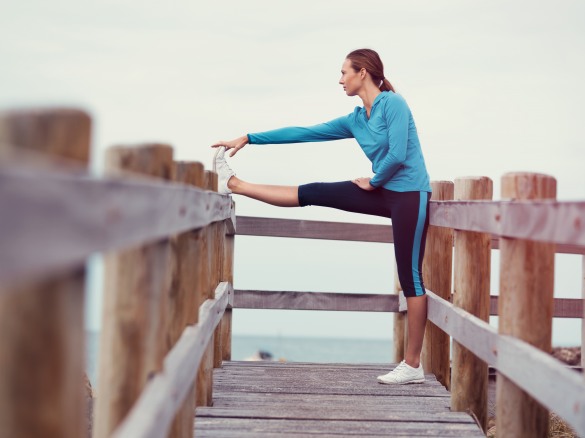
After a run, do not neglect stretching the triceps surae (calf).
At the end of training, allow yourself a moment of calm.
Running admittedly requires no sophisticated equipment, yet certain precautions deserve your full attention, in particular:
- Choose comfortable sports shoes in the right size.
- Do not run in casual trainers.
- Walk in your new shoes before running in them.
- Choose identical pairs so that switching pairs does not distort your stride.
Recent shoe models can improve performance, but above all they give better protection against injuries.
When running, the ground-contact phase is brief. The cushioning period — the heel landing on the ground — accounts for around 20% of the foot's total contact time. The forefoot propulsion period accounts for around 80%.
To reduce the (often painful) stress on the heel, using shock-absorbing materials (heel pads or insoles) lowers it by around 10 to 20%.
However, these materials lengthen the contact time with the ground.
As a result, to keep a constant running speed, more effort is needed during the push-off phase of the stride. The extra muscle work falls on the triceps surae (calf), hence increased stress on the Achilles tendon.
Conversely, a more elastic material recovers part of the energy from the compression of the sole at the heel, letting you move onto the forefoot more quickly — which means less time on the ground and less push-off stress.
In general, elite runners will choose light shoes that favour performance.
If you run without chasing elite performance, it is better to have shoes with a fairly wide sole (better stability) that is also thick (as the sole is made of shock-absorbing, elastic materials), which prevents tendon, muscle and joint problems. Individual morphological factors cannot be denied.
Running is the most effective revealer of certain physical anomalies: leg-length differences, valgus feet, varus feet, genu valgum, genu varum, lumbar hyperlordosis, excess weight.
Finally, need we recall the importance of a healthy lifestyle, enough sleep, limited alcohol, tobacco and coffee, a good dietary balance..., and regular sport.
These few tips will certainly not make you a champion, but at least they will spare you many troubles during your sport or your exercise and leisure sessions.
Charles EVRENIAN, santé pratique, revue Mutualité fonction publique, December 1988.


 Coach Kin Progressons ensemble